
When the Brain Suddenly Sees by Dr. Richie Davidson
A new neuroscience study reveals how insight reorganizes the brain—and why contemplative practice may train our capacity to see reality more clearly.


Many years ago, my colleagues and I were studying the brains of long-term meditation practitioners—individuals who had spent tens of thousands of hours training the mind.
During one experiment, we recorded brain activity using EEG while participants engaged in an open awareness meditation infused with compassion.
Then we looked at the raw data from one practitioner in particular: Yongey Mingyur Rinpoche.
As the signal streamed across the screen in the lab, something extraordinary appeared. Electrical traces from dozens of electrodes spread across the cortex suddenly rose and fell together in rapid synchrony.
For a moment we wondered if it was an artifact.
But it wasn’t.
We realized we were seeing something momentous—patterns of brain activity that had never been observed before.
The brain was generating extraordinarily strong gamma oscillations—fast neural rhythms around 30–80 Hz—synchronized across widely distributed regions of the cortex. Even more striking, this synchrony emerged almost immediately when Mingyur Rinpoche entered the meditative state.
Gamma synchrony has long been associated with moments when the brain integrates information across distributed neural systems—periods of perceptual binding, learning, and insight.
Seeing such powerful, large-scale synchrony suggested something profound: through training, the brain may become more capable of integrating information across neural networks. In other words, the capacity for insight itself may be trainable (Lutz et al., 2004).
Over the past two decades, neuroscience has begun to explore this possibility. A fascinating new study published recently in Nature Communications now provides fresh evidence about what happens in the brain during the moment of insight, revealing how sudden understanding reorganizes neural representations across the brain.
What the researchers discovered reinforces something contemplative traditions have suggested for centuries:
Insight is not merely intellectual.
It is a reorganization in how the mind represents reality.
When the Brain Reorganizes Perception
In the study, participants viewed ambiguous black-and-white images known as Mooney images. At first glance these pictures appear to be meaningless patterns of light and shadow.
The brain struggles to interpret them.
Then suddenly the image resolves.
A dog.
A face.
A spider.
What moments earlier looked like random shapes becomes instantly recognizable.
Using neuroimaging, the researchers observed a striking neural shift during this moment. Activity patterns in visual regions—particularly the ventral occipito-temporal cortex, which plays a key role in object recognition—reorganized dramatically.
Before insight, the brain encoded the image as disconnected fragments.
After insight, the same sensory input was represented as a coherent object.
The researchers describe this transformation as representational change.
What is especially cool about this experiment is that nothing about the external stimulus had changed.
But the brain had changed how it interpreted what it was seeing.
The world remained the same.
The mind reorganized.
The Emotional Spark of the “Aha”
Insight is not purely cognitive.
When participants experienced the sudden realization that revealed the hidden object, activity increased in the amygdala, which processes emotional salience, and the hippocampus, which detects novelty and supports memory formation.
This helps explain why insight feels so distinctive.
An “Aha!” moment carries a sense of surprise and emotional resonance. The brain registers that something important has happened.
And this matters for learning.
When participants were tested days later, problems solved through insight were far more likely to be remembered than those solved gradually.
Insight is therefore not simply a flash of understanding.
It is a powerful learning event.
The Brain as a Prediction Engine
To understand why insight can be transformative, it helps to recognize something fundamental about how the brain operates.
The brain is not a passive recorder of reality. Increasingly, neuroscience views perception as a process of prediction. The brain continuously generates models of the world and updates those models using incoming sensory information (Friston, 2010; Clark, 2013).
Most of the time these predictive models allow us to navigate the world efficiently.
But they can also become rigid.
We interpret ambiguous situations through habitual narratives about ourselves or others. These interpretations can become so familiar that they feel like reality itself.
Insight occurs when these predictive models are suddenly updated or reorganized. The brain recognizes that its previous interpretation was incomplete. A new representation emerges. And the same situation now appears in a different light. In this sense, insight may represent a moment of rapid neuroplasticity—when the brain abruptly reorganizes its internal models and begins to perceive the same world in a fundamentally different way.
This capacity for cognitive reorganization may also play an important role in trauma recovery, where healing often involves loosening rigid threat predictions and restoring the brain’s flexibility to interpret experience in new ways.
This figure beautifully illustrates the central thesis of the essay: insight is literally a reorganization of how the brain represents reality.
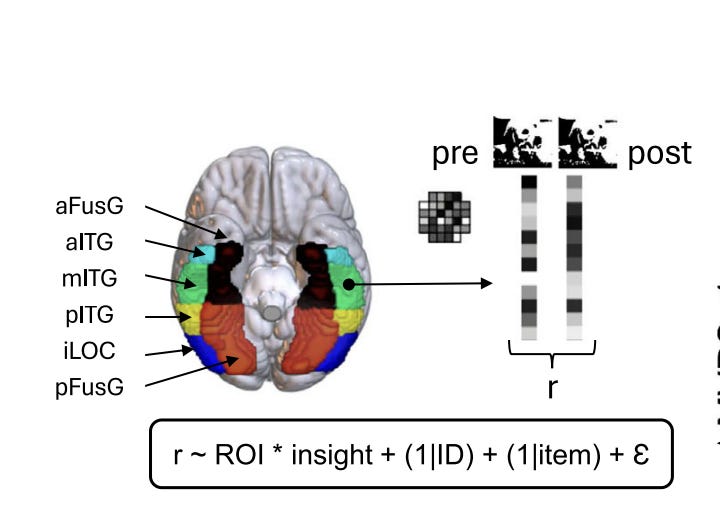
Brain activity during the moment of insight. When participants suddenly recognized the hidden object in an ambiguous image, patterns of neural activity in visual cortex reorganized dramatically. The same stimulus remained unchanged—but the brain’s internal representation shifted.
Insight in Contemplative Practice
Contemplative traditions have long emphasized this process.
In Buddhist psychology, insight involves seeing clearly the mental processes that construct our experience.
Through careful observation of the mind, practitioners come to recognize that:
thoughts are mental events rather than facts
emotions are dynamic processes rather than fixed states
the sense of self is a continually evolving construction
From a neuroscientific perspective, these realizations may reflect transformations in the brain’s predictive models of identity and experience.
The same principle that allows a Mooney image to suddenly resolve into a recognizable object may also allow our understanding of ourselves to shift.
When that shift occurs, patterns of suffering that once seemed inevitable can begin to loosen.
The brain is literally seeing differently.
