
Legendary Dan Goleman on the Power of Anger and Practicing Before Life Gets Hard
A conversation with the legends of neuroscience and practice with Richie Davidson & Cortland Dahl


We sat down with Daniel Goleman, the man who brought emotional intelligence into the mainstream, alongside Dr. Richie Davidson and Dr. Cortland Dahl. The conversation covered fifty years of friendship, a breakthrough paper that changed neuroscience, and a question that matters a lot right now: how do you handle yourself when things get hard?
Goleman’s answer: you practiced before.
Two meditative renegades in the ‘70s
Goleman and Davidson first met at Harvard around 1972. Dan had just come back from fifteen months in India studying with meditation masters. Richie walked up to him in a psychophysiology course and said, “Are you Dan Goleman?” He’d read an obscure paper Dan had written about consciousness.
They became co-conspirators. Their faculty had, in Dan’s words, “about zero interest in meditation as a topic.” They did their dissertations on it anyway. At the time, there were about three papers in the scientific literature on meditation. As Dan put it, “They weren’t very scientific either.”
Their first paper together introduced a concept they kept coming back to for the rest of their careers:
The after is the before for the next during.
As Richie explained:
“Transforming the baseline state so that the baseline you begin with the next time you meditate will be at least slightly different from the baseline that you started with initially. And that’s the incremental change toward an altered trait.”
— Richie Davidson
They called their later book Altered Traits, a play on altered states. The distinction matters. States are temporary. Traits are who you become when you’re not meditating.
“We’re really interested in how these practices can transform every nook and cranny of our lives, not the experience we may have when we’re meditating, but rather how it transforms our lives in general, all the time.”
— Dan Goleman
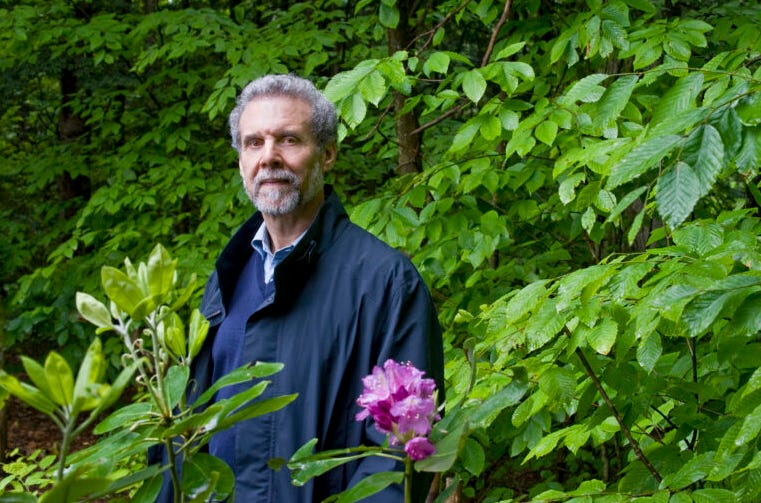
Dan Goleman
The meditation paper that changed neuroscience
In 2004, Richie’s lab published a paper in the Proceedings of the National Academy of Sciences. They brought some of the most accomplished meditators on the planet into the lab: Mathieu Ricard and Mingyur Rinpoche, people who had spent years of their lives in formal practice. The findings showed gamma oscillations at levels never previously recorded. Gamma waves are the brain’s way of coordinating activity across different regions at the same time. In simple terms, these meditators’ brains were working together in ways that the researchers had not seen before. And these differences showed up even at rest, before they started meditating.
“We studied them to see if their brains were different. Because if their brains were not different on the measures that we had, there would be no point in studying more novice meditators. But in fact, we found that their brains were dramatically different.”
— Richie Davidson
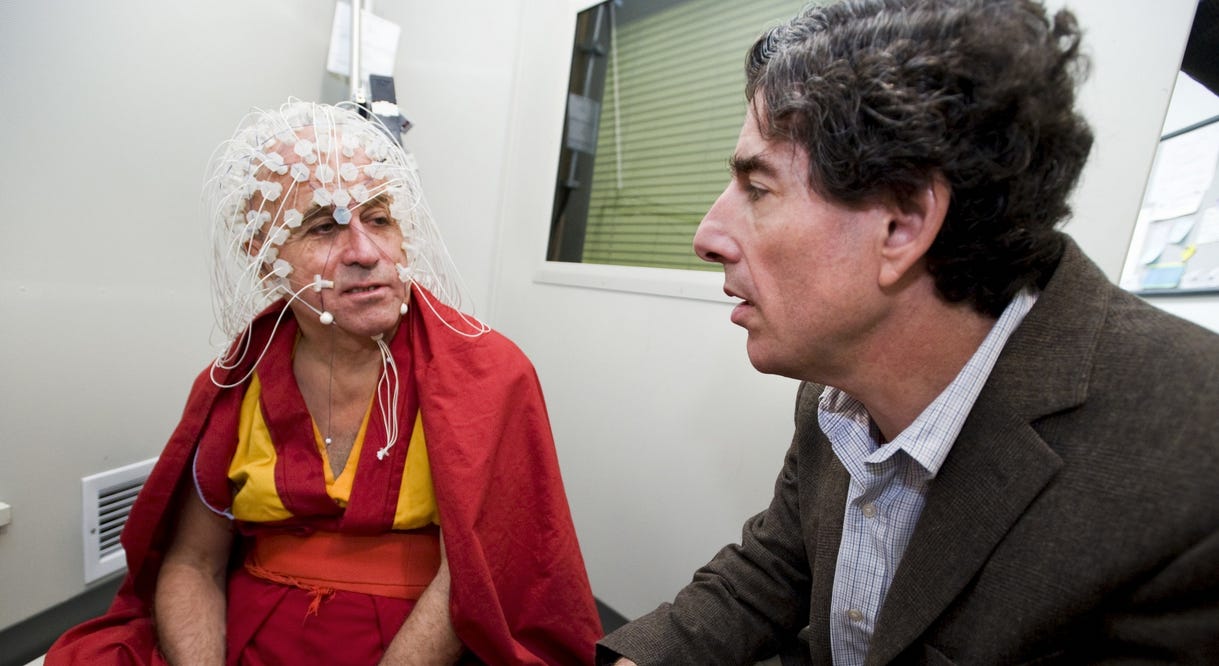
Dr. Richie Davidson with Matthieu Ricard
It was the first paper on meditation in the journal’s more than hundred-year history. Richie described it as “a real turning point that illustrated, particularly to hard-nosed mainstream neuroscience, that there really was a there there.”
Today there are hundreds if not thousands of papers published every year on these topics. When Dan and Richie were doing their dissertations, there were three.
The Dalai Lama’s advice on anger
Then the conversation turned personal. Cort shared what happened when he landed in Minneapolis earlier in the month, a city in crisis. He grew up there. His son is at the University of Minnesota. He’s worked in the immigrant communities there his whole adult life. And when he arrived, everything hit at once: fear, anger, anxiety, love, care, clear seeing.
He asked the question: what do you do with all of that?
Goleman went to the Dalai Lama’s advice on anger:
“It’s extremely useful. But to be skillful with anger, you need to put aside the hostility, the us and them, and preserve the focus it gives you, the motivation it gives you, the persistence it gives you, and apply that to find a skillful way to intervene in this situation.”
— Daniel Goleman, recounting the Dalai Lama
Then Cort asked the follow-up: how do you actually do that when you’re in the middle of it?
Goleman:
“The answer is you practiced before. It’s not the first time you got angry. You get angry. We get angry at this and that in life. I get angry on hold. Telephone trees make me angry. But what those are, are opportunities to rehearse.”
— Daniel Goleman
And:
“You could try tobogganing, but you wouldn’t expect to go to the Olympics as a tobogganer. You need to practice, and it’s true of any skill, including the skills for self-management, for self-awareness, for empathy.”
— Daniel Goleman
Our favorite takeaway from this conversation: you practiced before. Every moment you noticed your breath. Every time you caught a reaction before it ran you. Every time you observed an angry thought instead of acting on it. Those were training runs. And that is the whole point. We should always be practicing, so that when the moment comes, we are ready.
The full conversation is linked here.
— Dharma Lab